製品: RUNX2 Antibody
カタログ: AF5186
タンパク質の説明: Rabbit polyclonal antibody to RUNX2
アプリケーション: WB IHC IF/ICC
Cited expt.: WB, IHC, IF/ICC
反応性: Human, Mouse, Rat
予測: Pig, Bovine, Horse, Sheep, Rabbit, Chicken, Xenopus
分子量: 56kDa,48kDa; 57kD(Calculated).
ユニプロット: Q13950
RRID: AB_2837672

類似製品を見る>>

   サイズ 価格 在庫状況
 100ul $280 在庫あり
 200ul $350 在庫あり

リードタイム: 当日配達

For pricing and ordering contact:
お問い合わせ先

製品説明

ソース:
Rabbit
アプリケーション:
WB 1:500-1:2000, IHC 1:50-1:200, IF/ICC 1:100-1:500
*The optimal dilutions should be determined by the end user. For optimal experimental results, antibody reuse is not recommended.
*Tips:

WB: For western blot detection of denatured protein samples. IHC: For immunohistochemical detection of paraffin sections (IHC-p) or frozen sections (IHC-f) of tissue samples. IF/ICC: For immunofluorescence detection of cell samples. ELISA(peptide): For ELISA detection of antigenic peptide.

反応性:
Human,Mouse,Rat
予測:
Pig(100%), Bovine(100%), Horse(100%), Sheep(100%), Rabbit(100%), Chicken(100%), Xenopus(90%)
クローナリティ:
Polyclonal
特異性:
RUNX2 Antibody detects endogenous levels of total RUNX2.
RRID:
AB_2837672
引用形式: Affinity Biosciences Cat# AF5186, RRID:AB_2837672.
コンジュゲート:
Unconjugated.
精製:
The antiserum was purified by peptide affinity chromatography using SulfoLink™ Coupling Resin (Thermo Fisher Scientific).
保存:
Rabbit IgG in phosphate buffered saline , pH 7.4, 150mM NaCl, 0.02% sodium azide and 50% glycerol. Store at -20 °C. Stable for 12 months from date of receipt.
別名:

折りたたみ/展開

Acute myeloid leukemia 3 protein; Alpha subunit 1; AML3; CBF alpha 1; CBF-alpha-1; CBFA1; CCD; CCD1; Cleidocranial dysplasia 1; Core binding factor; Core binding factor runt domain alpha subunit 1; Core binding factor subunit alpha 1; Core-binding factor subunit alpha-1; MGC120022; MGC120023; Oncogene AML 3; Oncogene AML-3; OSF 2; OSF-2; OSF2; Osteoblast specific transcription factor 2; Osteoblast-specific transcription factor 2; OTTHUMP00000016533; PEA2 alpha A; PEA2-alpha A; PEA2aA; PEBP2 alpha A; PEBP2-alpha A; PEBP2A1; PEBP2A2; PEBP2aA; PEBP2aA1; Polyomavirus enhancer binding protein 2 alpha A subunit; Polyomavirus enhancer-binding protein 2 alpha A subunit; Runt domain; Runt related transcription factor 2; Runt-related transcription factor 2; RUNX2; RUNX2_HUMAN; SL3 3 enhancer factor 1 alpha A subunit; SL3-3 enhancer factor 1 alpha A subunit; SL3/AKV core binding factor alpha A subunit; SL3/AKV core-binding factor alpha A subunit;

免疫原

免疫原:

A synthesized peptide derived from human RUNX2, corresponding to a region within the internal amino acids.

Uniprot:
遺伝子(ID):
発現特異性:
Q13950 RUNX2_HUMAN:

Specifically expressed in osteoblasts.

タンパク質の説明:
Transcription factor involved in osteoblastic differentiation and skeletal morphogenesis. Essential for the maturation of osteoblasts and both intramembranous and endochondral ossification. CBF binds to the core site, 5'-PYGPYGGT-3', of a number of enhancers and promoters, including murine leukemia virus, polyomavirus enhancer, T-cell receptor enhancers, osteocalcin, osteopontin, bone sialoprotein, alpha 1(I) collagen, LCK, IL-3 and GM-CSF promoters.
タンパク質配列:
MASNSLFSTVTPCQQNFFWDPSTSRRFSPPSSSLQPGKMSDVSPVVAAQQQQQQQQQQQQQQQQQQQQQQQEAAAAAAAAAAAAAAAAAVPRLRPPHDNRTMVEIIADHPAELVRTDSPNFLCSVLPSHWRCNKTLPVAFKVVALGEVPDGTVVTVMAGNDENYSAELRNASAVMKNQVARFNDLRFVGRSGRGKSFTLTITVFTNPPQVATYHRAIKVTVDGPREPRRHRQKLDDSKPSLFSDRLSDLGRIPHPSMRVGVPPQNPRPSLNSAPSPFNPQGQSQITDPRQAQSSPPWSYDQSYPSYLSQMTSPSIHSTTPLSSTRGTGLPAITDVPRRISDDDTATSDFCLWPSTLSKKSQAGASELGPFSDPRQFPSISSLTESRFSNPRMHYPATFTYTPPVTSGMSLGMSATTHYHTYLPPPYPGSSQSQSGPFQTSSTPYLYYGTSSGSYQFPMVPGGDRSPSRMLPPCTTTSNGSTLLNPNLPNQNDGVDADGSHSSSPTVLNSSGRMDESVWRPY

種類予測

種類予測:

Score>80(red) has high confidence and is suggested to be used for WB detection. *The prediction model is mainly based on the alignment of immunogen sequences, the results are for reference only, not as the basis of quality assurance.

Species
Results
Score
Pig
100
Horse
100
Bovine
100
Sheep
100
Chicken
100
Rabbit
100
Xenopus
90
Dog
0
Zebrafish
0
Model Confidence:
High(score>80) Medium(80>score>50) Low(score<50) No confidence

研究背景

機能:

Transcription factor involved in osteoblastic differentiation and skeletal morphogenesis. Essential for the maturation of osteoblasts and both intramembranous and endochondral ossification. CBF binds to the core site, 5'-PYGPYGGT-3', of a number of enhancers and promoters, including murine leukemia virus, polyomavirus enhancer, T-cell receptor enhancers, osteocalcin, osteopontin, bone sialoprotein, alpha 1(I) collagen, LCK, IL-3 and GM-CSF promoters. In osteoblasts, supports transcription activation: synergizes with SPEN/MINT to enhance FGFR2-mediated activation of the osteocalcin FGF-responsive element (OCFRE) (By similarity). Inhibits KAT6B-dependent transcriptional activation.

PTMs:

Phosphorylated; probably by MAP kinases (MAPK). Phosphorylation by HIPK3 is required for the SPEN/MINT and FGF2 transactivation during osteoblastic differentiation (By similarity). Phosphorylation at Ser-451 by CDK1 promotes endothelial cell proliferation required for tumor angiogenesis probably by facilitating cell cycle progression. Isoform 3 is phosphorylated on Ser-340.

細胞の位置付け:

Nucleus.

Extracellular region or secreted Cytosol Plasma membrane Cytoskeleton Lysosome Endosome Peroxisome ER Golgi apparatus Nucleus Mitochondrion Manual annotation Automatic computational assertionSubcellular location
組織特異性:

Specifically expressed in osteoblasts.

タンパク質ファミリー:

A proline/serine/threonine rich region at the C-terminus is necessary for transcriptional activation of target genes and contains the phosphorylation sites.

研究領域

· Human Diseases > Cancers: Overview > Transcriptional misregulation in cancer.

参考文献
1). Gut microbial alterations in arginine metabolism determine bone mechanical adaptation. Cell metabolism, 2024 (PubMed: 38718794) [IF=27.7]

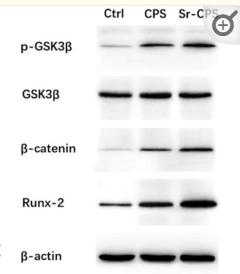
2). Osteoblastic and anti-osteoclastic activities of strontium-substituted silicocarnotite ceramics: In vitro and in vivo studies. Bioactive Materials, 2020 (PubMed: 32280833) [IF=18.9]

Application: WB    Species: Mice    Sample: bone and osteoid tissues

Fig. 4 (A) Expression of the osteogenesis-specific genes including RUNX2, BSP, OPN and OCN; (B) Western blotting showed that Sr-CPS affected the Wnt/β-catenin pathway-related proteins GSK3β, p-GSK3β, β-catenin and RUNX-2; (C) Quantification of the Western blotting. * Compared with the control group; # compared with CPS group.

Application: IHC    Species: Mice    Sample: bone and osteoid tissues

Fig. 9 (A) Masson staining: the region between surrounding bone and scaffold (40x & 100x); (B) TRAP staining: TRAP positive cells (black arrows); (C) IHC staining of RUNX-2; (D) IHC staining of ALP; (E) Quantitative analysis for TRAP staining and IHC staining. * Compared with CPS group; # compared with Sr-5 group.

3). Microenvironment-responsive multifunctional enzyme-linked hydrogel for diabetic bone defect regeneration. Nature communications, 2025 (PubMed: 41271711) [IF=16.6]

Application: IF/ICC    Species: Rat    Sample:

Fig. 4: Evaluation of the osteogenic promoting effect of AAT-ZCG in vitro. A AAT-ZCG promotes bone activity characterization. Created in BioRender. Chen, (https://BioRender.com/7n6p5gi). B, C Alizarin red staining and analysis of BMSCs treated with AAT-ZCG. D, E Alkaline phosphatase staining and analysis of BMSCs treated with AAT-ZCG. F, G BMP2 immunofluorescence staining and analysis. Blue: DAPI, excitation wavelength (Ex): 405 nm, endow with pseudo-color: RGB (0, 0, 255); Green: F-actin, Ex: 488 nm, endow with pseudo-color: RGB (0, 255, 0); Red: BMP2, Ex: 561 nm, endow with pseudo-color: RGB (255, 0, 0). H, I Runx2 immunofluorescence staining and analysis. Blue: DAPI, excitation wavelength (Ex): 405 nm, endow with pseudo-color: RGB (0, 0, 255); Green: F-actin, Ex: 488 nm, endow with pseudo-color: RGB (0, 255, 0); Red: Runx2, Ex: 561 nm, endow with pseudo-color: RGB (255, 0, 0). The expression of osteogenic genes was verified by q-PCR, J Spp1, K Bglap, L BMP2, M) Sp7. Data are presented as mean ± SD. Figure 4C, E, G, I–M involved three biological replications (n = 3) and analysis of these experiments’ results were performed using one-way ANOVA. ns, no statistical significance. *P 

4). Antibacterial Peptides-Produced Cell Hydrogel Eliminates Intracellular Pathogens and Remodels Immune Microenvironment for Osteomyelitis Therapy. ACS nano, 2025 (PubMed: 40336314) [IF=15.8]

5). Gene-Activating Framework Nucleic Acid-Targeted Upregulating Sirtuin-1 to Modulate Osteoimmune Microenvironment for Diabetic Osteoporosis Therapeutics. ACS nano, 2024 (PubMed: 39689347) [IF=15.8]

6). Gene-Activating Framework Nucleic Acid-Targeted Upregulating Sirtuin-1 to Modulate Osteoimmune Microenvironment for Diabetic Osteoporosis Therapeutics. ACS nano, 2024 (PubMed: 39689347) [IF=15.8]

7). Vascular Derived ECM Improves Therapeutic Index of BMP‐2 and Drives Vascularized Bone Regeneration. Small, 2022 (PubMed: 35218305) [IF=13.0]

8). Fusion peptide engineered “statically-versatile” titanium implant simultaneously enhancing anti-infection, vascularization and osseointegration. Biomaterials, 2021 (PubMed: 33069134) [IF=12.8]

9). Gold nanoparticles targeting the autophagy–lysosome system to combat the inflammation-compromised osteogenic potential of periodontal ligament stem cells: From mechanism to therapy. Biomaterials, 2022 (PubMed: 36030103) [IF=12.8]

10). Polydatin accelerates osteoporotic bone repair by inducing the osteogenesis-angiogenesis coupling of bone marrow mesenchymal stem cells via the PI3K/AKT/GSK-3β/β-catenin pathway. International journal of surgery (London, England), 2025 (PubMed: 39248296) [IF=12.5]

もっと読みます

Restrictive clause


Affinity Biosciences tests all products strictly. Citations are provided as a resource for additional applications that have not been validated by Affinity Biosciences. Please choose the appropriate format for each application and consult Materials and Methods sections for additional details about the use of any product in these publications.

For Research Use Only.
Not for use in diagnostic or therapeutic procedures. Not for resale. Not for distribution without written consent. Affinity Biosciences will not be held responsible for patent infringement or other violations that may occur with the use of our products. Affinity Biosciences, Affinity Biosciences Logo and all other trademarks are the property of Affinity Biosciences LTD.