製品: SMCR7/MID49 Antibody
カタログ: DF12044
タンパク質の説明: Rabbit polyclonal antibody to SMCR7/MID49
アプリケーション: WB IHC IF/ICC
Cited expt.: WB
反応性: Human, Mouse, Rat, Monkey
予測: Horse
分子量: 49 kDa; 49kD(Calculated).
ユニプロット: Q96C03
RRID: AB_2844849

類似製品を見る>>

   サイズ 価格 在庫状況
 100ul $280 在庫あり
 200ul $350 在庫あり

リードタイム: 当日配達

For pricing and ordering contact:
お問い合わせ先

製品説明

ソース:
Rabbit
アプリケーション:
WB 1:500-1:2000, IHC 1:50-1:200, IF/ICC 1:100-1:500
*The optimal dilutions should be determined by the end user. For optimal experimental results, antibody reuse is not recommended.
*Tips:

WB: For western blot detection of denatured protein samples. IHC: For immunohistochemical detection of paraffin sections (IHC-p) or frozen sections (IHC-f) of tissue samples. IF/ICC: For immunofluorescence detection of cell samples. ELISA(peptide): For ELISA detection of antigenic peptide.

反応性:
Human,Mouse,Rat,Monkey
予測:
Horse(86%)
クローナリティ:
Polyclonal
特異性:
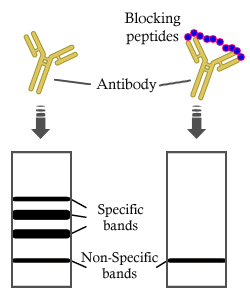
SMCR7/MID49 Antibody detects endogenous levels of total SMCR7/MID49.
RRID:
AB_2844849
引用形式: Affinity Biosciences Cat# DF12044, RRID:AB_2844849.
コンジュゲート:
Unconjugated.
精製:
The antiserum was purified by peptide affinity chromatography using SulfoLink™ Coupling Resin (Thermo Fisher Scientific).
保存:
Rabbit IgG in phosphate buffered saline , pH 7.4, 150mM NaCl, 0.02% sodium azide and 50% glycerol. Store at -20 °C. Stable for 12 months from date of receipt.
別名:

折りたたみ/展開

MGC23130; MID49; MID49_HUMAN; MIEF2; Mitochondrial dynamic protein MID49; Mitochondrial dynamic protein of 49 kDa; Mitochondrial dynamics protein MID49; Mitochondrial dynamics protein of 49 kDa; Mitochondrial elongation factor 2; Smith Magenis syndrome chromosome region candidate 7; Smith-Magenis syndrome chromosomal region candidate gene 7 protein;

免疫原

免疫原:

A synthesized peptide derived from human SMCR7/MID49, corresponding to a region within the internal amino acids.

Uniprot:
遺伝子(ID):
発現特異性:
Q96C03 MID49_HUMAN:

Expressed in all tissues tested with highest expression in heart and skeletal muscle.

タンパク質配列:
MAEFSQKRGKRRSDEGLGSMVDFLLANARLVLGVGGAAVLGIATLAVKRFIDRATSPRDEDDTKADSWKELSLLKATPHLQPRPPPAALSQPVLPLAPSSSAPEGPAETDPEVTPQLSSPAPLCLTLQERLLAFERDRVTIPAAQVALAKQLAGDIALELQAYFRSKFPELPFGAFVPGGPLYDGLQAGAADHVRLLVPLVLEPGLWSLVPGVDTVARDPRCWAVRRTQLEFCPRGSSPWDRFLVGGYLSSRVLLELLRKALAASVNWPAIGSLLGCLIRPSMASEELLLEVQHERLELTVAVLVAVPGVDADDRLLLAWPLEGLAGNLWLQDLYPVEAARLRALDDHDAGTRRRLLLLLCAVCRGCSALGQLGRGHLTQVVLRLGEDNVDWTEEALGERFLQALELLIGSLEQASLPCHFNPSVNLFSSLREEEIDDIGYALYSGLQEPEGLL

種類予測

種類予測:

Score>80(red) has high confidence and is suggested to be used for WB detection. *The prediction model is mainly based on the alignment of immunogen sequences, the results are for reference only, not as the basis of quality assurance.

Species
Results
Score
Horse
86
Pig
71
Bovine
71
Dog
71
Chicken
58
Rabbit
57
Sheep
0
Xenopus
0
Zebrafish
0
Model Confidence:
High(score>80) Medium(80>score>50) Low(score<50) No confidence

研究背景

機能:

Mitochondrial outer membrane protein which regulates mitochondrial organization. It is required for mitochondrial fission and promotes the recruitment and association of the fission mediator dynamin-related protein 1 (DNM1L) to the mitochondrial surface independently of the mitochondrial fission FIS1 and MFF proteins. Regulates DNM1L GTPase activity.

細胞の位置付け:

Mitochondrion outer membrane>Single-pass membrane protein.
Note: Colocalizes with DNM1L at mitochondrial membrane. Forms foci and rings around mitochondria.

Extracellular region or secreted Cytosol Plasma membrane Cytoskeleton Lysosome Endosome Peroxisome ER Golgi apparatus Nucleus Mitochondrion Manual annotation Automatic computational assertionSubcellular location
組織特異性:

Expressed in all tissues tested with highest expression in heart and skeletal muscle.

タンパク質ファミリー:

Belongs to the MID49/MID51 family.

参考文献

1). MicroRNA-27b alleviates septic cardiomyopathy by targeting the Mff/MAVS axis. Frontiers in cellular and infection microbiology, 2025 (PubMed: 40766842) [IF=4.6]

Application: WB    Species: Mouse    Sample:
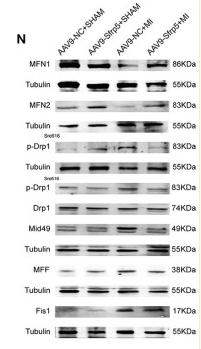
Figure 4 miR-27b reduces mitochondrial fission by targeting Mff. (A, B), RT-qPCR detection of miR-27b and Mff mRNA expression levels in each cell group. (C–F), Quantitative analysis of Mff, Drp1, Mid49, and Mid51 protein expression levels by Western blot. (G), Representative Western blot bands for each group. (H), Dual-luciferase reporter assay verifying the targeting relationship between miR-27b and Mff; upper panel shows wild-type (WT) and mutant-type (MT) Mff 3’UTR sequence diagrams. (I), Transmission electron microscopy observation of mitochondrial ultrastructure in each cell group, scale bar=500 nm. (J), Confocal laser scanning microscopy observation of MFF expression and subcellular localization in each cell group, scale bar=50 μm. #P

2). Resveratrol promotes mitophagy via the MALAT1/miR-143-3p/RRM2 axis and suppresses cancer progression in hepatocellular carcinoma. Journal of integrative medicine, 2025 (PubMed: 39675939) [IF=4.2]

3). Secreted Frizzled-Related Protein 5 Protects Against Cardiac Rupture and Improves Cardiac Function Through Inhibiting Mitochondrial Dysfunction. Frontiers in Cardiovascular Medicine, 2021 (PubMed: 34568442) [IF=2.8]

Application: WB    Species: Mouse    Sample: Heart tissue

Figure 4 Sfrp5 decreased apoptosis and improved mitochondrial dysfunction. (A) Cardiomyocyte apoptosis determined by TUNEL staining. Scale bars = 25 μm. (B) Statistical analysis of TUNEL-positive cells (values are presented as mean ± SD, n = 6 per group). (C) Protein expression of Bax and Bcl-2 in mouse hearts at 14 days after MI. (D) Quantitative analysis of the relative Bcl-2/Bax ratio (n = 5 per group). (E) Macrophage infiltration determined by immunohistochemistry. Scale bars = 50 μm. (F) Statistical analysis of F4/80-positive cells (values are presented as mean ± SD, n = 6 per group). (G) IL1β mRNA expression (n = 6 per group). β-Actin was used as a loading control (values are presented as mean ± SD, n = 6 per group). (H) Quantitative analysis of the NADH oxidase activity level (values are presented as mean ± SD, n = 6 per group). (I) Quantitative analysis of the ATP level (values are presented as mean ± SD, n = 6 per group). (J) Quantitative analysis of the NAD+/NADH ratio (values are presented as mean ± SD, n = 5–6 per group). (K) Mitochondrial morphology was detected by TEM. Scale bars = 1 μm. (L) Quantitative analysis of the size of the mitochondria (values are presented as mean ± SD, n = 6 per group). (M) Quantitative analysis of the mitochondrial number/total area (values are presented as mean ± SD, n = 6 per group). (N) Protein expression of mitochondrial fusion proteins (MFN1 and MFN2) and mitochondrial fission proteins (p-Drp1Ser616, p-Drp1Ser616/Drp, Mid49, MFF, and Fis1) in mouse hearts at 14 days after MI (n = 5 per group). (O) Quantitative analysis of the relative MFN1 protein expression. Tubulin was used as a loading control. (P) Quantitative analysis of the relative MFN2 protein expression. Tubulin was used as a loading control. (Q) Quantitative analysis of the relative p-Drp1Ser616. Tubulin was used as a loading control. (R) Quantitative analysis of the relative p-Drp1Ser616/Drp. (S) Quantitative analysis of the relative Mid49 protein expression. Tubulin was used as a loading control. (T) Quantitative analysis of the relative MFF protein expression. Tubulin was used as a loading control. (U) Quantitative analysis of the relative Fis1 protein expression. Tubulin was used as a loading control. *p < 0.05 AAV9-NC-MI mice at 14 days after MI vs. AAV9-Sfrp5-MI mice at 14 days after MI. **p < 0.01 AAV9-NC-MI mice at 14 days after MI vs. AAV9-Sfrp5-MI mice at 14 days after MI. ***p < 0.001 AAV9-NC-MI mice at 14 days after MI vs. AAV9-Sfrp5-MI mice at 14 days after MI.

4). Interval and continuous exercise overcome memory deficits related to β-Amyloid accumulation through modulating mitochondrial dynamics. BEHAVIOURAL BRAIN RESEARCH, 2019 (PubMed: 31445975) [IF=2.6]

Application: WB    Species: mouse    Sample: hippocampus
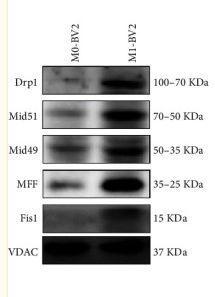
Fig. 5.| HIIT and MICT ameliorated mitochondrial fission and fusion in the hippocampus of APP/PS1 transgenic mice. The levels of DRP1 (a), FIS1 (b), MFF (c),MID49 (d), MID51 (e), MFN1 (f), MFN2 (g) and OPA1 (h) were detected in the hippocampus.

5). M1 Microglia Induced Neuronal Injury on Ischemic Stroke via Mitochondrial Crosstalk between Microglia and Neurons. Oxidative Medicine and Cellular Longevity, 2022 (PubMed: 36478988)

Application: WB    Species: Mouse    Sample: M0-BV2 and M1-BV2 cells

Figure 3 Mitochondrial changes in activated microglia (M1). (a) Schematic diagram of intracellular mitochondrial fusion and fission process in microglia after OGD/R. (b) Western blot assay of mitochondrial fusion protein (Opa1 and Mfn1), TOM20, and cytochrome c in mitochondria of M0 and M1 microglia (n = 3). Results are displayed in a form of mean ± SD; ∗P < 0.05, ∗∗P < 0.01, and ∗∗∗P < 0.001. (c) Western blotting findings of mitochondrial fission protein including MFF, Fis1, Mid49, and Mid51 in mitochondria of M0 and M1 microglia (n = 3). Data presented are mean ± SD; ∗∗P < 0.01 and ∗∗∗P < 0.001. (d) Mitochondrial function in M1 microglia and M0 microglia was investigated by determining ATP (n = 3), mitochondria membrane potential (n = 3), and ROS (n = 3). The relative ratio of intracellular ATP was determined by calculating the ratio of level of ATP in M0-BV2 and M1-BV2 cells to level of ATP in M0-BV2 cells. Results are displayed in a form of mean ± SD. ∗∗P < 0.01 and ∗∗∗P < 0.001. (e) Morphology of intracellular mitochondria in BV2 cells visualized under TEM, scale bar: 1.0 μm.

Restrictive clause


Affinity Biosciences tests all products strictly. Citations are provided as a resource for additional applications that have not been validated by Affinity Biosciences. Please choose the appropriate format for each application and consult Materials and Methods sections for additional details about the use of any product in these publications.

For Research Use Only.
Not for use in diagnostic or therapeutic procedures. Not for resale. Not for distribution without written consent. Affinity Biosciences will not be held responsible for patent infringement or other violations that may occur with the use of our products. Affinity Biosciences, Affinity Biosciences Logo and all other trademarks are the property of Affinity Biosciences LTD.