製品: Phospho-MLKL (Ser358) Antibody
カタログ: AF7420
タンパク質の説明: Rabbit polyclonal antibody to Phospho-MLKL (Ser358)
アプリケーション: WB IHC
Cited expt.: WB, IHC
反応性: Human, Mouse, Rat
分子量: 54kDa; 54kD(Calculated).
ユニプロット: Q8NB16
RRID: AB_2843860

類似製品を見る>>

   サイズ 価格 在庫状況
 100ul $350 在庫あり
 200ul $450 在庫あり

リードタイム: 当日配達

For pricing and ordering contact:
お問い合わせ先

製品説明

ソース:
Rabbit
アプリケーション:
WB 1:500-1:2000, IHC 1:50-1:200
*The optimal dilutions should be determined by the end user. For optimal experimental results, antibody reuse is not recommended.
*Tips:

WB: For western blot detection of denatured protein samples. IHC: For immunohistochemical detection of paraffin sections (IHC-p) or frozen sections (IHC-f) of tissue samples. IF/ICC: For immunofluorescence detection of cell samples. ELISA(peptide): For ELISA detection of antigenic peptide.

反応性:
Human,Mouse,Rat
クローナリティ:
Polyclonal
特異性:
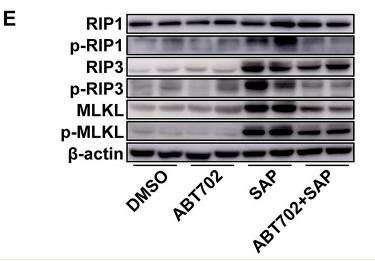
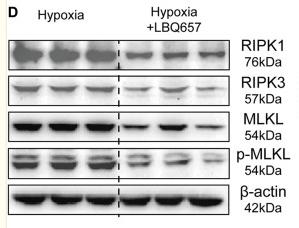
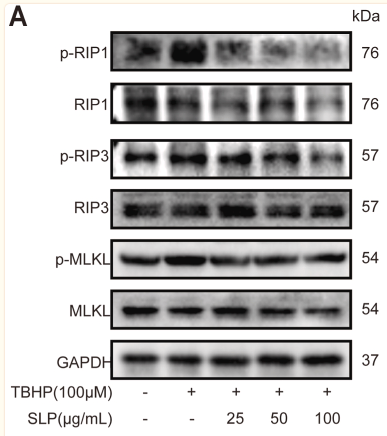
Phospho-MLKL (Ser358) Antibody detects endogenous levels of MLKL only when phosphorylated at Ser358(Human) or Ser345(Mouse).
RRID:
AB_2843860
引用形式: Affinity Biosciences Cat# AF7420, RRID:AB_2843860.
コンジュゲート:
Unconjugated.
精製:
The antibody is from purified rabbit serum by affinity purification via sequential chromatography on phospho-peptide and non-phospho-peptide affinity columns.
保存:
Rabbit IgG in phosphate buffered saline , pH 7.4, 150mM NaCl, 0.02% sodium azide and 50% glycerol. Store at -20 °C. Stable for 12 months from date of receipt.
別名:

折りたたみ/展開

9130019I15Rik; FLJ34389; hMLKL; Mixed lineage kinase domain like; Mixed lineage kinase domain like protein; Mixed lineage kinase domain like pseudokinase; Mixed lineage kinase domain-like protein; Mlkl; MLKL_HUMAN;

免疫原

免疫原:

A synthesized peptide derived from human MLKL around the phosphorylation site of Ser358.

Uniprot:
遺伝子(ID):
タンパク質配列:
MENLKHIITLGQVIHKRCEEMKYCKKQCRRLGHRVLGLIKPLEMLQDQGKRSVPSEKLTTAMNRFKAALEEANGEIEKFSNRSNICRFLTASQDKILFKDVNRKLSDVWKELSLLLQVEQRMPVSPISQGASWAQEDQQDADEDRRAFQMLRRDNEKIEASLRRLEINMKEIKETLRQYLPPKCMQEIPQEQIKEIKKEQLSGSPWILLRENEVSTLYKGEYHRAPVAIKVFKKLQAGSIAIVRQTFNKEIKTMKKFESPNILRIFGICIDETVTPPQFSIVMEYCELGTLRELLDREKDLTLGKRMVLVLGAARGLYRLHHSEAPELHGKIRSSNFLVTQGYQVKLAGFELRKTQTSMSLGTTREKTDRVKSTAYLSPQELEDVFYQYDVKSEIYSFGIVLWEIATGDIPFQGCNSEKIRKLVAVKRQQEPLGEDCPSELREIIDECRAHDPSVRPSVDEILKKLSTFSK

研究背景

機能:

Pseudokinase that plays a key role in TNF-induced necroptosis, a programmed cell death process. Activated following phosphorylation by RIPK3, leading to homotrimerization, localization to the plasma membrane and execution of programmed necrosis characterized by calcium influx and plasma membrane damage. Does not have protein kinase activity. Binds to highly phosphorylated inositol phosphates such as inositolhexakisphosphate (InsP6) which is essential for its necroptotic function.

PTMs:

Phosphorylation by RIPK3 induces a conformational switch that is required for necroptosis. It also induces homotrimerization and localization to the plasma membrane.

細胞の位置付け:

Cytoplasm. Cell membrane.
Note: Localizes to the cytoplasm and translocates to the plasma membrane on necroptosis induction.

Extracellular region or secreted Cytosol Plasma membrane Cytoskeleton Lysosome Endosome Peroxisome ER Golgi apparatus Nucleus Mitochondrion Manual annotation Automatic computational assertionSubcellular location
タンパク質ファミリー:

The protein kinase domain is catalytically inactive but contains an unusual pseudoactive site with an interaction between Lys-230 and Gln-356 residues. Upon phosphorylation by RIPK3, undergoes an active conformation (By similarity).

The coiled coil region 2 is responsible for homotrimerization.

Belongs to the protein kinase superfamily.

研究領域

· Cellular Processes > Cell growth and death > Necroptosis.   (View pathway)

· Environmental Information Processing > Signal transduction > TNF signaling pathway.   (View pathway)

参考文献

1). Dual-mode action of scalable, high-quality engineered stem cell-derived SIRPα-extracellular vesicles for treating acute liver failure. Nature communications, 2025 (PubMed: 39988725) [IF=16.6]

Application: IHC    Species: Mouse    Sample: liver

Fig. 1: CD47 is overexpressed on necroptotic hepatocytes in the damaged liver of ALF models. A Biochemical evaluation (AST and ALT levels) of the ALF model after APAP induction (left). Representative images of H&E and CD47 staining of liver samples from an ALF model induced by APAP (right) (n = 4). B CD47 expression levels of cell populations within liver tissue (n = 4). C CD47 expression in hepatocytes from normal and APAP-ALF livers (n = 3). D Graphical representation of early apoptotic (Annexin V+/7-AAD−), late apoptotic/necroptotic (Annexin V+/7-AAD+), and necrotic (Annexin V−/7-AAD+) cell populations in liver hepatocytes from normal (n = 4) and APAP-ALF (n = 3) mice. E Expression of RIP3 and pMLKL in liver samples from normal and APAP-ALF groups. F Representative confocal images of liver sections from normal and APAP-ALF mice. Scale bar, 50 μm. G Scatter plot visualization of the Spearman correlation (R) between 121 necroptosis gene scoring and RNA levels of CD47 across samples. H STopover analysis to map the spatial overlap and interactions between cell types in liver tissue from normal and APAP-ALF mice. Highlights include 121 necroptosis gene scores (yellow) and macrophage RNA levels (blue), with overlapping areas shown in green. The plots below represent the three regions. I Violin plot visualizing SIRPα expression levels in different regions based on spatial correlation results. The numbers marked on the plot represent the median values of the SIRPα expression. Bar graph data are presented as mean ± SD. Statistical significance was determined by two-tailed unpaired Student’s t test (A), two-way ANOVA with Sidak’s post hoc test (B, D), and two-tailed test (G). Hepa hepatocytes, Immune immune cells, Endo endothelial cells. Source data are provided as a Source Data file.

2). RIPK1 kinase drove brain microvascular endothelial cells death and blood-brain barrier disruption in neonatal Escherichia coli meningitis. Nature communications, 2025 (PubMed: 40774959) [IF=16.6]

Application: WB    Species: human    Sample: hBMECs

Fig. 1: RS218 induced multiple death pathways in BMECs in vitro and in vivo. a Time-lapse microscopy of PI-stained (red) hBMECs infected with RS218 (MOI = 10), showing 8 min interval images taken at 60 × magnification. The 10 frames demonstrated the progression of cell death within 72 min before membrane rupture. White dashed lines indicate the boundaries of the cell membrane. Scale bar, 20 μm. b, c hBMECs stimulated with RS218 (MOI = 1 or 10) were used to determine cytotoxicity by LDH release (b, n = 3 biologically independent samples) and kinetics of cell death of PI penetration (c, n = 5 biologically independent samples). d, e hBMECs were pretreated with NSA or zVAD alone or in combination for 0.5 h, and cytotoxicity (d, n = 6 biologically independent samples) and cell death kinetics of PI penetration (e, n = 3 biologically independent samples) were assayed. f Flow cytometry of Annexin V-FITC and PI staining in hBMECs infected with RS218 (MOI = 1). Representative images of immunofluorescence represented morphological analysis of Annexin V-FITC and PI-labeled cells for the indicated times postinfection. Scale bar, 20 μm. g Immunoblot analysis of MLKL phosphorylation, GSDMD, caspase-3, and PARP1 cleavage in hBMECs infected with RS218 (MOI = 1) at the indicated times. Blots for GAPDH served as loading controls. +, indicated pharmacologically-induced death of hBMECs. FL, full-length. h Pro caspase-8 was co-immunoprecipitated with RIPK1, RIPK3, ZBP1 and ASC in uninfected or RS218-infected hBMECs (MOI = 1) for 3 h. i Immunofluorescence representative images of 2-day-old mice brain tissue sections 18 h after injection. The nucleus was labeled in blue, pMLKL or GSDMD-N or caspase-3 p17 in green, and endothelial cell marker CD31 in red. Scale bar, 20 μm. All experiments were representative of at least three independent experiments with similar results. Bars indicated the mean plus SD. Statistical significance was determined by one-way ANOVA with Tukey’s post-hoc test, with P-values denoted as follows: **** P 

3). Ir(III) Complexes Convert Cold to Hot Tumors via Ferroptosis/Necroptosis-Driven Immunogenic Cell Death and Photosensitized CD47 Downregulation. Advanced science (Weinheim, Baden-Wurttemberg, Germany), 2025 (PubMed: 41298247) [IF=15.1]

Application: WB    Species: human    Sample: MDA-MB-231 cells

Figure 3 Ir1-mediated PDT induces ferroptosis and necroptosis to initiate ICD in MDA-MB-231 cells. (a) Effects of pharmacological inhibitors on the antiproliferative efficacy of Ir1-PDT (n = 6). (b and c) Western blot analysis of protein expression profiles modulated by Ir1-PDT (n = 3). (d) Extracellular ATP levels in MDA-MB-231 cell supernatants (n = 3). (e and f) Immunofluorescence analysis of CRT (e) and HMGB1 (f) expression following Ir1-PDT treatment. Ir1: 0.1 µM, n = 3. Scale bar: 100 µm. Data are presented as mean ± SEM.

4). Staphylococcus aureus reprograms CASP8 (caspase 8) signaling to evade cell death and Xenophagy. Autophagy, 2025 (PubMed: 40143428) [IF=14.6]

5). Engineered cell membrane vesicles loaded with lysosomophilic drug for acute myeloid leukemia therapy via organ-cell-organelle cascade-targeting. Biomaterials, 2025 (PubMed: 39778270) [IF=14.0]

6). High-dose ascorbic acid selectively induces pyroptosis in LKB1-deficient lung cancer and sensitizes immunotherapy. Cell reports. Medicine, 2025 (PubMed: 40818456) [IF=11.7]

7). Inflammation-driven biomimetic nano-polyphenol drug delivery system alleviates severe acute pancreatitis by inhibiting macrophage PANoptosis and pancreatic enzymes oversecretion. Journal of advanced research, 2025 (PubMed: 40210149) [IF=11.4]

Application: WB    Species: Mouse    Sample: BMDMs

Fig. 4. PTX formulations inhibited macrophage PANoptosis. (A) Gene clustering analysis of PTX, FePTX, FePTX@CM-treated BMDMs. (B-C) GSEA analysis of transcriptomics results of BMDMs after LPS intervention. (D-E) Inflammatory-related pathway analysis in transcriptomics results of BMDMs after different PTX formulation interventions. (F) Heatmap of transcriptional profiling of inflammatory factors in BMDMs after PTX formulation interventions. (G) Results of qPCR sequencing (n = 4). (H) Cell viability of BMDMs with different treatments (n = 4). (I) PI staining images of BMDMs after LPS and FePTX@CM NPs treatment and its analysis (n = 4). Scale bar = 100 μm. (J) WB detection of the PANoptosis biomarkers in BMDMs upon treatment with FePTX@CM NPs. (K) TEM images of BMDMs after different treatments. Scale bar = 5 μm. (L) Co-IP analysis of PANoptosomes biomarkers in RAW264.7 after various interventions (n = 4). *P < 0.05, **P < 0.01, ***P < 0.001, N.s. = no significance. Data = mean ± SD.

8). CircHIPK3 targets DRP1 to mediate hydrogen peroxide-induced necroptosis of vascular smooth muscle cells and atherosclerotic vulnerable plaque formation. Journal of advanced research, 2025 (PubMed: 38621622) [IF=11.4]

9). Integrative analysis of immunogenic PANoptosis and experimental validation of cinobufagin-induced activation to enhance glioma immunotherapy. Journal of experimental & clinical cancer research : CR, 2025 (PubMed: 39901195) [IF=11.3]

10). Integrated Studies on Male Reproductive Toxicity of Decabromodiphenyl Ethane in Zebrafish Spermatozoa Ex Vivo, Male Zebrafish in Vivo, and GC-1 Cells in Vitro. Environmental health perspectives, 2024 (PubMed: 39570742) [IF=10.1]

もっと読みます

Restrictive clause


Affinity Biosciences tests all products strictly. Citations are provided as a resource for additional applications that have not been validated by Affinity Biosciences. Please choose the appropriate format for each application and consult Materials and Methods sections for additional details about the use of any product in these publications.

For Research Use Only.
Not for use in diagnostic or therapeutic procedures. Not for resale. Not for distribution without written consent. Affinity Biosciences will not be held responsible for patent infringement or other violations that may occur with the use of our products. Affinity Biosciences, Affinity Biosciences Logo and all other trademarks are the property of Affinity Biosciences LTD.